
At Gwladys Street Community Primary and Nursery School we are proud to welcome children and their families from a diverse range of cultures and backgrounds. We currently have thirty-eight languages spoken with children learning English at a wide range of stages.


School Of Sanctuary Global School Alliance
Gwladys Street Community Primary and Nursery School
Welcome to Our Diverse School Community
Over the years, our school community has become increasingly diverse, with around 38 different languages spoken at Gwladys Street School
We strive to ensure that all pupils feel safe, accepted, and valued, which helps them learn effectively and grow into successful members of society.
For children learning English as an additional language (EAL), we recognise and celebrate their home languages and cultural backgrounds.
The Importance of Bilingualism
Bilingualism is a valuable skill. EAL children make significant contributions to our school and the wider community.
Being bilingual allows access to two cultures and promotes tolerance of other cultures, enriching the learning environment for everyone.
Celebrating Cultural Diversity
At Gwladys Street School, we create an inclusive environment that celebrates cultural diversity through events like Cultural Diversity Days and our Language of the Term initiative. These activities build confidence and boost self-esteem for our EAL pupils.
Assessment of EAL Students
Department for Education Classification Codes
We follow the Department for Education’s EAL classification codes to assess students.

Additionally, we use the Bell Foundation Framework for EAL to support our assessments.

Key areas of assessment include:
– Listening
– Speaking
– Reading
– Writing
Each term, we assess children using a 10-step assessment tracker to ensure they are progressing well in their learning journey.
Curriculum Planning for EAL Students
We carefully plan our curriculum to meet the specific needs of EAL children and ensure all pupils have opportunities to make good progress.
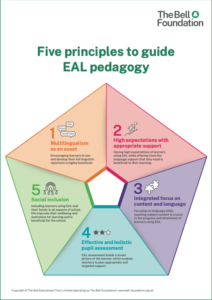
How We Support EAL Children
– Collaborative group work
– Use of visual aids in lessons
– Pre-teaching of vocabulary
– Drama and role play
Visual resources like mind maps, substitution tables, pictures, and writing frames
Extra Support Options
Small group work
Withdrawal from class (if necessary) for additional support
Why We Provide Extra Support:
To facilitate rapid progress, e.g. through daily 1:1 phonics tutoring
To boost confidence through focused attention
Pre-teaching of vocabulary to support links with the main lesson
–
How You Can Help at Home
Language Support
Speak your first language! Research shows that concepts learned in a child’s first language are transferred to their second language.
Embrace your language in public – don’t be afraid to speak it with your child.
Engage in bilingual activities: Take your child to gatherings where they can hear and use their home language.
Reading and Language Development
Read stories to your child in your first language. This fosters pride in their heritage and helps maintain a strong connection to their language.
Teach songs and nursery rhymes in your language to promote a sense of cultural identity.
Oxford Owl eBook Library has a great range of books, including audio books.
Register with your local library to access dual language books.
Make sure to read for 20 minutes a day and ask your child questions as you read together to enhance comprehension.
For Read Write Inc Phonics support, please ask us for more information.
Additional Home Support Ideas
After-school clubs can help develop social language skills.
Shared activities like cooking, playing games, watching movies, and singing songs are great for language development.
Encourage your child to keep diaries, scrapbooks, and vocabulary lists to build their vocabulary and support expressive language skills.
Homework Support
Read tasks in English, but discuss them in your first language to ensure understanding.
Switching between languages can enhance understanding and is beneficial for the brain.
Speak to your child’s teacher if your child continues to struggle.
General Tips for Supporting Your Child
Limit screen time during meals, bedtime, and homework time.
Ensure a consistent bedtime routine – children aged 5-11 need 9-11 hours of sleep each night.
A healthy breakfast improves energy levels and concentration throughout the day.
Gwladys Street Community Primary and Nursery School: EAL Statement
Intent
The strategic aims of our EAL provision are to:
- Create Belonging: Ensure all EAL pupils feel safe, welcomed, and fully included as vital members of the Gwladys Street Family.
- Celebrate Identity: Value and celebrate linguistic diversity as an asset, promoting bilingualism and multilingualism.
- Drive Achievement: Maintain the highest standards of academic expectations, ensuring EAL learners make rapid, sustained progress.
- Ensure Equity: Provide seamless equity of access to a broad, balanced, and ambitious curriculum.
- Empower Communicators: Support pupils to become confident, fluent speakers, readers, and writers of English while preserving their home languages.
- Foster Global Citizenship: Develop all pupils’ understanding of different cultures, promoting empathy and global citizenship.
Implement
Whole-Classroom Strategies (Quality First Teaching)
Our teachers use research-backed scaffolding to ensure EAL learners access the full curriculum alongside their peers:
- Visual & Contextual Support: Extensive use of graphic organizers, mind maps, real objects (realia), and visual timetables.
- Scaffolded Literacy: Application of writing frames, substitution tables, pictures, and bilingual word banks.
- Vocabulary Instruction: Explicit pre-teaching and dual-coding of key tier 2 (academic) and tier 3 (subject-specific) vocabulary.
- Collaborative Learning: Structured peer-pairing, talk partners, and collaborative group work to build classroom confidence.
- Oracy-Rich Environments: Prioritizing drama, role-play, and structured speaking frames before asking pupils to write.
Targeted & Tailored Support
When pupils require accelerated language acquisition, we deploy targeted interventions:
- Structured Phonics: Daily 1:1 or small-group phonics tutoring utilizing the Read Write Inc. programme to facilitate rapid progress.
- Pre-Teaching Sessions: Short, impactful pre-teaching of vocabulary and concepts before main lessons to boost classroom confidence and make clear links to learning.
-
Impact (How We Measure Success)
Our EAL provision ensures that language is never a barrier to a child’s ambition or success. We measure the impact of our approach through the following outcomes:
-
Rapid Language Acquisition: EAL pupils make strong, measurable progress through the 10-step tracker and transition smoothly through the DfE proficiency codes (A to E).
-
Academic Achievement: Internal data and national standardized assessments demonstrate that EAL learners at Gwladys Street achieve outcomes that match or exceed their peers from similar starting points.
-
Curriculum Equity: Regular learning walks, book looks, and lesson observations show that EAL learners are fully engaged with a broad, balanced, and ambitious curriculum, demonstrating high levels of vocabulary acquisition.
-
Confidence and Oracy: Pupils speak confidently, articulately, and proudly about their learning, comfortably code-switching between English and their home languages.
-
A Culture of Belonging: Attendance figures, pupil voice surveys, and high participation in after-school clubs reflect that our EAL children feel safe, valued, and fundamentally part of the “Gwladys Street Family.”
-
Strong Community Partnership: Parents of EAL children actively engage with homework, reading initiatives, and school events, feeling empowered to support their child’s bilingual journey at home.
-
for EAL and Language of the month resources please click the link below.