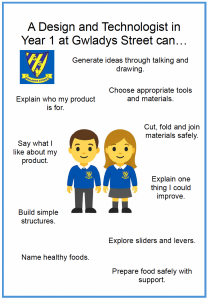
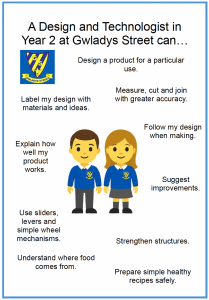
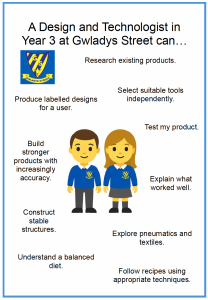
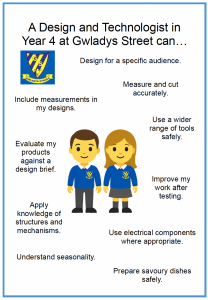
Intent
At Gwladys Street we use the Kapow Primary curriculum to provide a broad, balanced and ambitious foundation curriculum for all children across KS1 and KS2. Through carefully sequenced lessons, children develop the knowledge, skills and vocabulary needed to become confident, curious and independent learners. We aim to inspire pupils to be innovative, resilient and reflective learners who develop technical knowledge, creativity and problem-solving skills. We would like to ensure that all children leave Gwladys Street with an enthusiasm and enjoyment for Design and Technology.
Our curriculum is designed to:
- Inspire creativity, curiosity and a love of learning. Children develop creativity and imagination within the subject and develop a lasting interest that will stay with them for the rest of their lives.
- Build knowledge progressively from Year 1 to Year 6.
- Develop children’s confidence in speaking, listening, problem-solving and critical thinking.
- Ensure all pupils, including those with SEND and disadvantaged pupils, can access and succeed in learning while developing resilience, independence, critical thinking and creativity.
- Provide meaningful opportunities for children to apply their learning in real-life contexts. Children are given opportunities to investigate, design and make products, whilst enabling children to become resourceful and innovative. Children are able to solve real and relevant problems, considering their own and others’ needs, wants and values.
- Promote resilience, independence and collaboration through practical and engaging experiences.
- Wherever possible, learning is linked to other curriculum areas including mathematics, science, computing and art, enabling children to make meaningful connections across subjects. Children are also given opportunities to reflect upon and evaluate existing and past designs, considering their effectiveness and influence the world around them.
Using Kapow ensures clear progression, strong subject knowledge and consistency across the school while allowing teachers to adapt learning to meet the needs and interests of our children and community. Our Design and Technology curriculum is designed to equip pupils with the knowledge, skills and creativity needed to solve real-world problems. We aim to develop resilient learners who are able to take risks, learn from mistakes and understand how design and technology impact everyday life and future careers. Through meaningful experiences, pupils develop an appreciation of innovation, and the role technology plays in shaping the modern world.
Implementation
The Kapow curriculum is implemented through high-quality teaching and carefully planned sequences of learning across KS1 and KS2. Lessons are designed to progressively build knowledge and skills while revisiting prior learning to strengthen understanding and retention.
Teachers implement the curriculum through:
- Clear lesson sequences with defined knowledge and skills progression.
- Engaging practical activities, investigations and discussion opportunities.
- Retrieval practice and revisiting key vocabulary to support long-term memory.
- Adaptive teaching strategies to ensure learning is accessible for all pupils.
- Cross-curricular links where appropriate to deepen understanding and provide context.
- Opportunities for collaborative learning, creativity and independent thinking.
- Ongoing assessment through questioning, observation and outcomes to inform next steps.
Children are encouraged to explore, question, practise and reflect on their learning, helping them to develop confidence and independence across the curriculum.
Through focused teaching, children are taught the key areas of the Design and Technology process:
Design:
- Use research and develop design criteria to inform the design of innovative, functional, appealing products that are fit for purpose, aimed at particular individuals or groups.
- Generate, develop, model and communicate their ideas through discussion, annotated sketches, cross-sectional diagrams, prototypes, pattern pieces and computer aided design.
Make:
- Select from and use a wider range of tools and equipment to perform practical tasks (for example, cutting, shaping, joining and finishing) accurately.
- Select from and use a wider range of materials and components, including construction materials, textiles and ingredients, according to their functional properties and aesthetic qualities.
Evaluate:
- Investigate and analyse a range of existing products.
- Evaluate their ideas and products against their own criteria and consider the views of others to improve their work.
- Understand how key events and individuals in Design and Technology have helped shape the world.
Technical knowledge:
- Apply their understanding of how to strengthen, stiffen and reinforce more complex structures.
- Understand and use mechanical systems in their products.
- Understand and use electrical systems in their products.
- Apply their understanding of computing to program, monitor and control their products.
Impact
The impact of our Kapow curriculum is that children leave each year group with secure knowledge, subject-specific skills and a positive attitude towards learning. Pupils are able to talk confidently about their learning, use subject-specific vocabulary accurately and apply their knowledge across different contexts.
Through our curriculum, children:
- Make good progress from their starting points.
- Develop resilience, independence and creativity.
- Retain key knowledge and skills over time. Children will ultimately know more, remember more and understand more about Design and Technology, demonstrating their knowledge when using tools or skills in other areas of the curriculum and in opportunities out of school.
- Produce high-quality outcomes across the curriculum.
- Show enthusiasm and engagement in lessons. Children will have a clear enjoyment and confidence in Design and Technology that they will then apply to other areas of the curriculum.
- Are prepared for the next stage of their education. The large majority of children will achieve age related expectations in Design and Technology by the end of each year.
The success of the curriculum is monitored through pupil voice, lesson observations, assessment opportunities, work scrutiny and ongoing teacher assessment to ensure all children achieve their potential.
EYFS
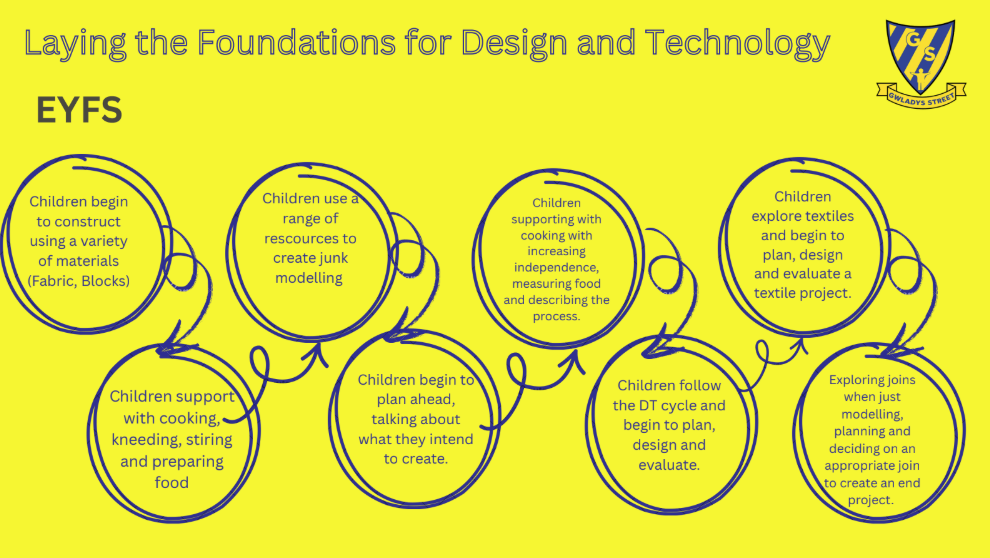
In the Early Years Foundation Stage (EYFS), Design and Technology is taught through practical and hands-on experiences. Children are encouraged to explore, design, make and evaluate through a range of engaging activities that develop creativity, problem-solving and fine motor skills. The Design and Technology curriculum within the Early Years forms part of the learning acquired for ‘Understanding the World’. Children in the Foundation Stage access Design and Technology activities throughout continuous provision and are encouraged to use their learning experiences with a purpose in mind using a variety of resources. Through Design and Technology experiences, children develop the Characteristics of Effective Learning by playing and exploring, actively learning and creating and thinking critically. Children are encouraged to be independent in their learning, staff encourage this through carefully planned child-led and adult-led adult led activities, which allow children to access a wide range of resources both indoors and outdoors. Children are regularly encouraged to reflect on their learning, which closely links with the evaluating skills expected in Key Stage One and Two.
Pupil Voice: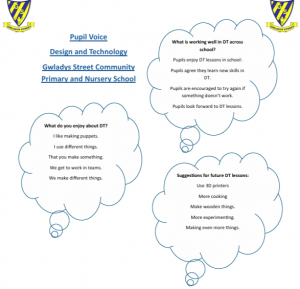
Design and Technology in Action:
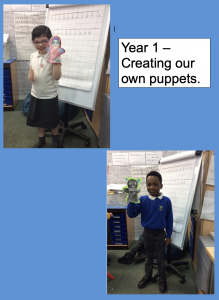
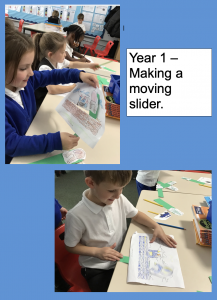
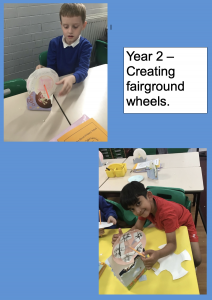
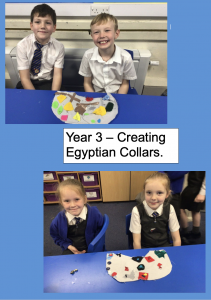
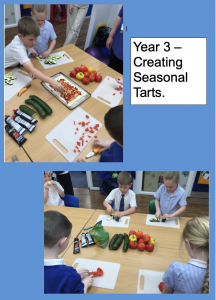

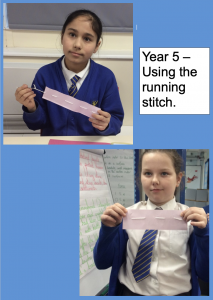
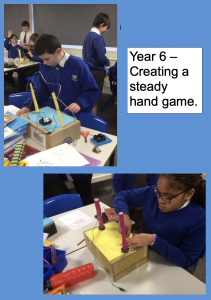
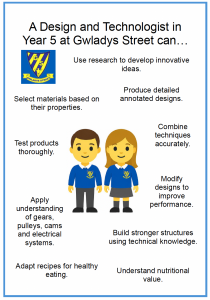
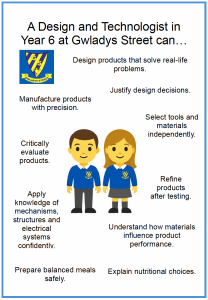
A Design and Technologist at Gwladys Street Primary School can…